
For in-depth advice on the types of immigration documents available for a specific nationality, you can rely on the services of our immigration lawyer in Australia, who can explain the legal procedures a foreigner should expect when relocating here (applying for a visa, obtaining a residence permit in Australia, renewing his or her immigration documents and others).
| Quick Facts | |
|---|---|
| Entry visa requirement (from EU) (YES/NO) | Yes, EU citizens need to obtain a visa even for short stays. |
Entry visa requirement (outside EU) (YES/NO) | Yes, necessary for all foreigners, with the exception of New Zealand citizens, who can enter Australia without a visa, but who will receive the SCV visa upon entry. |
Types of visas available | Visas for tourism and visits/ visas for study / work visas / permanent residency visas / family reunification visas / humanitarian visas / refugee visas / other category |
| Time frame for obtaining work visa (approx.) | It varies greatly depending on the visa stream – for instance, for the permanent work visa of Subclass 186, the processing time can vary from 5 to 20 months. |
| Validity of temporary residence permit | It depends on the visa that granted the residency permit – usually, the permit is available for 18-24 months, but it can increase to 4-5 years. |
| Time frame for obtaining permanent residence (approx.) | In general, permanent residency can be acquired after 4 years of living here – the document can be issued in 6 to 12 months. |
| Investor Visa Availability (YES/NO) | Yes (Subclass 891) |
| Sponsorship requirement (YES/NO) | Yes (it depends on the visa the applicant needs) |
| Time frame for obtaining citizenship | One can start this process after 1 year of being a permanent resident in Australia – applications for citizenship by descent are processed in approx 5 months, while applications for citizenship by conferral, in 9-17 months. |
| Citizenship/Residency by investment scheme availability (YES/NO) | There isn’t a direct program for citizenship, but permanent residency is available through investments. |
| Tax benefits for expats | They can apply on employment matters, capital gains and others / temporary residents do not have to pay taxes in Australia. |
| Visa issuance fees | The fees vary from AUD 0 to AUD 13,860. |
Fees charged for the issuance of a residence permit | AUD 1160 – AUD 4640 (they vary based on the age of the applicant and the type of permit). |
Institution in charge with the immigration formalities | Immigration services in Australia are completed with the assistance of the Department of Home Affairs. |
| Right to appeal a visa refusal (yes/no) | Yes |
| When can a person make an appeal | A foreigner can make an appeal if the visa application has been denied within a certain amount of time since the date of the decision (9 days for situations regulated under the Section 501 and 501CA of the Migration Act 1958 or 28 days for all other situations). The appeal can be made for all situations, including those of refusal for the issuance of a protection visa, or of those refused on character grounds. |
| Fee exemption for the issuance of a residence permit (yes/no) | No |
| When can a foreigner be exempted from fee payment | Immigration services in Australia offered by the Australian immigration institutions can be exempted from the payment of fees for certain categories of visas (for example, Subclass 802 – Child visa, Subclass 808 – Confirmatory Residence Visa, Bridging Visa A/C/D/F, etc.). |
| How long does it take to obtain a business visa? | It depends on the business stream selected by the investor. Visa applications can be processed in a period of up to 36 months or even more (such as it is the case for the Subclass 888 – Business Innovation and Investment visa). |
| Registration obligations | Persons who are issued with Australian visas that grant the right to residency here must apply for an ImmiCard, which is similar to an identity card fo foreigners available on the Australian territory. |
| What happens in case of overstaying a visa? | Overstaying a visa can have negative consequences for a person. Provided that the person has contacted the immigration authorities withing the first 28 days since the expiration of the visa, a bridging visa can be issued (but this depends on the visa the person initially was issued with). For overstays longer than 28 days, a period of exclusion from any other visas will apply. The person can be arrested, deported and required to pay specific fees associated with the procedure. |
| Ways to acquire citizenship | Citizenship in Australia can be acquired by birth, by descent or by conferral (naturalization). |
| Requirements for citizenship by naturalization | The person must be a permanent resident (living in Australia for minimum 4 years under a permanent visa), initiate the application from Australia, show intention of staying in Australia, be the holder of a Special Category visa for at least 12 months prior to the application. |
| Fees for citizenship application | AUD 0 to AUD 540. |
| Residency rights for refugees | Refugees receive the right to long-term residency (of 3 years) which can later be transformed in permanent residency. They can work in Australia, if they meet the basic requirements, and they are entitled to receiving assistance in finding a job, obtaining financial assistance based on their needs (children, disability, etc.), obtaining housing. |
| Laws on immigration in Australia | Immigration services in Australia, immigration rules and regulations and other procedures are prescribed by the Migration Act 1958 and the Migration Regulations 1994. |
How can you assist me in the process of immigrating to Australia?
Our immigration lawyer in Australia has the qualification in providing any immigration-related services. In the list below, you can observe some of our main legal services:
- information on the applicable law (rules may vary based on the nationality);
- assistance on the immigration documents you can acquire when you immigrate to Australiaand over the years (visas, residence permits, citizenship certificate, Australian passport);
- tailored legal representation in accordance to your specific case (arriving for investment, skilled/unskilled work, family reunification, etc.);
- assistance in preparing the visa application file and ongoing support during the processing of the documentation;
- post-relocation services (you can address us for any legal matter you may have after your relocation – renting a property, opening a bank account, obtaining a bank loan, etc.).
What are the main categories of visas in Australia?
Visas in Australia are divided between the following:
• general work visas – persons who would like to immigrate to Australia can apply for a Temporary Skills Shortage Visa, a Training Visa or a Working Holiday Visa, to name a few;
• visas for skilled employees – foreigners can obtain visas such as the Temporary Graduate Skilled Visa, the Skilled Work Regional Visa or the Skilled Nominated Visa;
• visas for study purposes –our immigration lawyer in Australiacan help young foreigners in enrolling with local education institutions by applying to one of the numerous visa options available for this category of persons;
• visas for family reunification programs – such visas are available for persons living here who want to bring their close family members to Australia, such as parents, spouses or children, but foreigners can also apply for fiancé visas, which allow the right to get married to a person with Australian citizenship;
• business visas – foreigners interested in developing a business here can apply for various business visas (issued on a temporary basis) that can provide the right to permanent residency in this country (through a residence permit in Australia).
What are the main categories of visas for employment in Australia?
Immigration in Australia for employment can be achieved through the following visa categories:
• visas created for innovation purposes, which aim at attracting highly skilled employees;
• visas issued for temporary work in Australia – in some cases, the applicant will need to obtain a sponsorship;
• visa issued for permanent employment in Australia– here, there is a wide range of options available for foreigners and our immigration lawyer in Australia can present the full list of visas;
• visas issued for skilled occupations – they are addressed to certain professionals who are in demand on the local employment market.
Is it possible to obtain the refugee status in Australia?
The legislation for immigration in Australia provides visas for humanitarian reasons, but also visas for refugees which can be granted for onshore purposes or for offshore purposes, depending on the location of the respective asylum seeker. Generally speaking, persons seeking asylum in Australia can apply for a Protection visa (subclass 866), which provides the right to permanent protection.
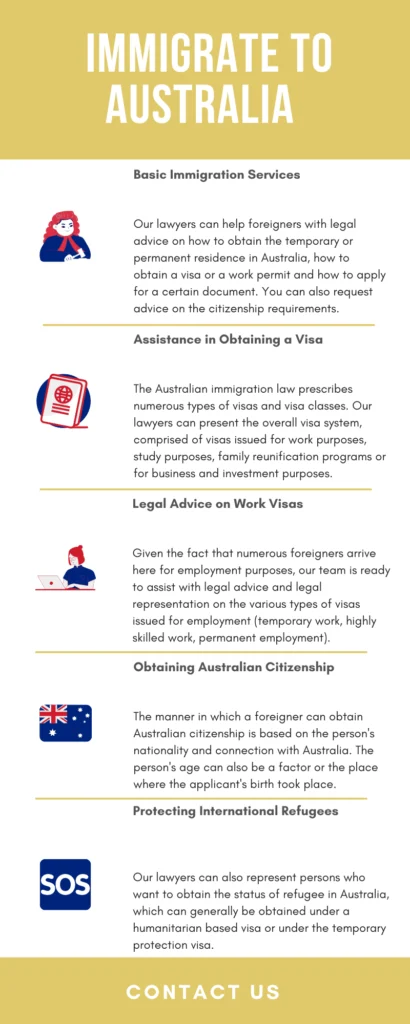
The infographic below presents how to immigrate to Australia:
What are the visa processing times in Australia?
The processing times vary greatly based on the visa you need to obtain. As a general rule, temporary visas have shorter processing times, while permanent visas take longer to be processed. In the list below, our immigration lawyer in Australia presents some of the timeframes you should expect:
- a visitor visa (temporary document) can be processed in 1 business day;
- a working holiday visa (temporary) is processed in around 13 days;
- if you want to apply for a student visa in Australia, you need to expect around 28 days to receive an answer on the application;
- a skilled visa (issued for temporary stay) is processed in approximately 63 days;
- a skilled visa issued for permanent stay can have significantly longer processing times – it can take up to 10 months;
- if you want to arrive here under a partner visa, it can take around 18 months until you will receive an answer.
How can I obtain residency in Australia?
Residency in Australia can be granted on a temporary or permanent basis. The latter can be obtained through 3 main visa pathways:
- visas issued for employment;
- visas for business purposes or for investors;
- visas issued for family reunification.
Can a foreigner become an Australian citizen?
Yes, foreigners can become Australian citizens. There are several ways through which foreigners can obtainAustralian citizenship.
A short presentation on our immigration services in Australia is available in the video below:
What are the main ways to obtain citizenship?
There are several legal options for becoming an Australian citizen. According to the law, the following types of citizenship are recognized in Australia:
- citizenship by conferral (it refers to citizenship requested on account of years of residency in Australia);
- citizenship by birth;
- citizenship by descent;
- citizenship granted to New Zealand citizens, who have a special status in this sense.
How long does it take to become a citizen?
It depends on the legal pathway you qualify for. For instance, those who apply for citizenship by conferral (based on the years of residency in Australia), need to have at least 4 years of lawful stay in the country.
There are different legal requirements based on the specific situation of a foreigner and this is why we invite you to address our immigration lawyer in Australia for professional legal advice and legal representation.